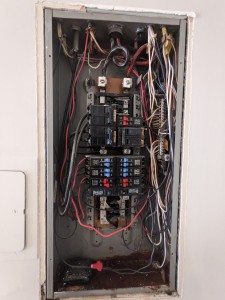
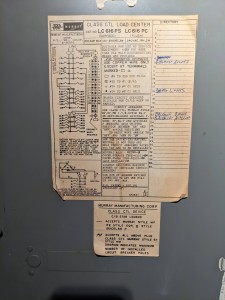
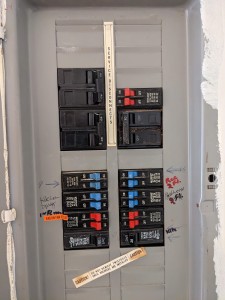
I bought the house last year, built in late 60's. I'm just now getting to the electrical work I want to do. I'm wanting to run a 240v 10/3 line to a shed, and also add a 40amp 240v line for a hottub in the future. I pulled the cover off the wall for the first time today and saw this mess. Can I replace the hot buses on this with a 100 or 200 amp main? Or should I just replace the entire panel? Does the house need a 200 or 100 amp main? Thanks!
Can I replace the entire bus and put in a main service disconnect breaker?
Mar 05, 2023
Last reply: 3 years ago
9 Replies
First question would be about the service entrance conductors. Are they big enough for the added load you plan?
Put a clamp amp meter on your mains at different times of the day to see your actual load. Many people have enough amp capacity but they run out of breaker space for more circuits.
And obviously given the decrapitated condition of what's there, replace the panel and do the simple changes to bring it up to today's safety codes, eg GFCI, AFCI, etc. Make it 150 or 200, if the service supports it and depending on what other loads may be coming. You have 40 for the spa, potentially 30 for the shed right there.
I'm not up on current code. Do you need to run 10/4 for the added circuits? The idea is to keep neutral and equipment ground separated as far up as stream as possible. The meter socket is the ideal spot for them to merge.
Yes, you need neutral and ground for those new circuits. He said 10/3 to the shed, in the nomenclature that usually means 10/3 plus ground, which is what he needs. For the hot tub 40A he needs 8 gauge, 8/3 most likely so he will have 120V too, which the hot tub probably needs. And GFCI on both of those. The thing in his favor is that it's a small panel with not many circuits, so replacing the crap that's there first before spending more money on top of it isn't going to cost all that much. As you pointed out, can the existing service support it all? If not, then it's going to get a lot more expensive.
I was thinking the same thing. Looks like water got in it . I could not see a neutral wire coming into the panel. It might be that I just missed it but did not see one coming in the same hole as the 2 hot wires.
The incoming wires do not look large enough for a 200 amp service either.
I wonder, too, about voltage drop. How far away is the power company meter? How far away is the shed?
The size panel you need is based on a calculation - what are major loads, square footage and area use. No information is given on any of that.
The rating is based on the service conductors - size & insulation type. That may not be easy to tell. My guess is that the wires are #4 - 100A. Not likely any larger.
Normally you can get the service amp rating from the service disconnect breaker rating. In this case it is a "split-bus" panel - all the breakers in the top section are service disconnects and the total of their ratings can be well over (or less than) the rating of the service conductors. Reading the breakers, the total on one leg is 130A and 170A on the other - that may or may not be a problem. The tandem/half-size breaker doesn't belong on the top. You can have a maximum of 6 service disconnects - you have 5 now. The bottom right breaker feeds the bottom section of the panel. If you keep the split-bus panel it is particularly important to do a service calculation. The label says the panel is rated
200A. The actual rating of what you have can be anything up to 200.The panel does not look that bad to me - except rust on the bottom. Doesn't look to me like much of a mess.
Unless you know more than is apparent you shouldn't do the work of replacing the panel. There are a lot of unique features in doing a service
Note that electrocution is not the only hazard working around service wires. The service conductors have very little protection, and shorts can have currents over 5000A - can melt a screwdriver
There should be a neutral-ground bond in the service panel. There had better be - the neutral bus has both ground and neutral wires.
Grounding (bonding) of the service entry parts is more complicated than downstream. EMT from the service panel to the meter enclosure usually won't ground the enclosure. The neutral in the meter enclosure is commonly connected (electrically and mechanically) to the enclosure and that is how the enclosure is grounded.
That's what I thought too initially. Took some close looking to see that it's there. It's in the shadow on the right of the other two, barely visible in the back, snakes around to the right and you can see the other end attached to the top of the neutral bar.
Agree.
Join the Discussion
Have something to add? Share your thoughts — no account required.
Didn't find your answer?
Ask the community — no account required