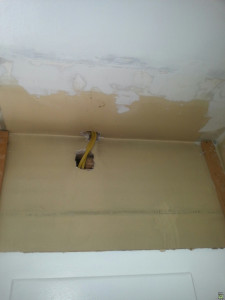
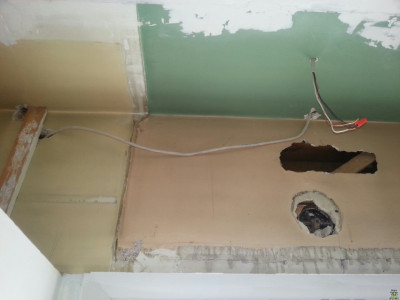
In our kitchen, 3 different Romex wires come down from the attic into the main room and then into the wall to power 3 different outlets. We'd like to redrill the attic holes to be behind the wall so this wire isn't exposed. There appears to be a ~4inch beam that we'll need to drill through (I am assuming this is why the wire comes into the room and then snakes back into the wall - to avoid this beam?)
Is this a problem to drill three small holes in the center of this beam?
any advice is appreciated!
Didn't find your answer? Ask the community — no account required.
Hi Thanks for replying. Here are some pictures of what i'm trying to do - [IMG]
formatting link
J
John Grabowski
*That 4" beam sounds like a double top plate which is supporting the floor above. No problem drilling through it for wires, but keep your holes small and not too close together. Around here (NJ) those holes are supposed to be sealed with a fire rated caulk which you can find at Home Depot. Watch out for nails. As someone else mentioned, a picture would be very helpful.
D
DerbyDad03
As others have mentioned, pictures would help.
I'd like to know what you mean by "exposed". Where are they exposed? In full view of anyone in a room? I hope not!
Please explain what you mean by "exposed".
S
SethF
Exposed as the picture shows in the above post. Thanks for the input.
T
TomR
Your links didn't work for me, but I re-formatted them above and also here:
formatting link
formatting link
.
Hopefully, these will work.
M
Metspitzer
How about putting a soffit there or let the wires come into a cabinet? The wire that is cut can be moved into the soffit with an exposed cover or into the cabinet with a junction box.
You should mark one of those romex with black tape at the ceiling an where it exits the wall in case you do have to cut them. You should be able to tell them apart.
If you do decide to drill into the beam you can cut a larger opening in the sheet rock and drill up.
The romex that is cut is required to have the splices in a junction box that you can get to the cover. It can be in the attic.
T
TomR
It looks like these wires used to be in a soffit or above/behind cabinets.
I am not sure, but you may be able to chisel out a couple of small channels, push the wires back into those channels so they would be behind the surface of the wall and ceiling, cover the wires in those areas with metal nailing plates so that no one could accidentally nail into the wires, and then patch over the those areas with plaster. If that is do-able, and if it is legal code-wise, that would save you from having to drill holes and re-route the wires.
D
dpb
Not totally conclusive but presuming that the one is the top of the top plate from the attic and the other is the same top plate from inside the kitchen, with the simple caveat already noted of being certain there's nothing else hidden where your drill's going to go, it surely appears that's what should've been done in the first place.
Looks like inept previous homeowner addition? If so, I'd recommend checking sizes of wiring re: breakers and for proper connection of neutrals vis a vis grounds and hots and also ensure no other faux pas like intermediary junctions or the like.
What's on these circuits and are they separate circuits and if so, why? It's possible that perhaps the even better solution would be to simply extend an existing circuit if they're just additional outlets altho need to ensure what the loading/count/locations are. Likely in the kitchen they also need GFCI now even though may not have when originally down.
So, likely the answer to the specific question asked is "yes" but there's also likely more to the question than asked to have a complete answer.
G
Gordon Shumway
Based on those pictures it looks like you could drill the necessary holes through the top plate and sill plate (beam) to reroute the wires without a problem. I am assuming your "beam" is wood. As long as your drywall is going to need some work anyway it would be best to enlarge the holes in the drywall so you can get a better look around the area you're going to be drilling into to make sure there are no other wires, plumbing, phone lines, satellite cable or dead animal carcasses you could damage.
G
gfretwell
Gordon is on the right track. I assume you can get the wires loose on the end in that room. Cut out a pretty good size rectangle in the wall and ceiling, drill up through the top plate once you see you are not going to hit anything else, reroute the wire and do your drywall patch. A big hole is usually easier to fix than a small hole (spanning stud to stud, tape and mud like a regular joint).,
J
John Grabowski
*It looks as though you removed the soffitt and found exposed wires. I have seen that happen a few times. Just one of those surprises that comes up during a remodeling job. If those wires were installed during the original construction, you probably will not be able to yank them out because they will be stapled to the side of the wood stud as it goes down the wall. You may have to cut a few holes in the wall to free them up. However the plaster walls and the gas pancake box tell me that this is a much older house and the wires shown are newer. That means that the wires could have been fished down the walls and should be able to be pulled back out.
The other possibility is to cut them and pull them up into the attic and install an accessible junction box. Then fish down new wires from the newly installed accessible junction box through the top plate. Leave the old wires in the wall if you can't get them out.
M
Metspitzer
BTW there is no way I would be trying to do any of that from the attic. You have finished sheet rock to do. Make you a big work hole.
M
Metspitzer
If you cut the sheet rock to half of the stud, it makes things much easier to put back.
M
Metspitzer
(16 inch work hole)
M
Metspitzer
If you look in the attic and choose the spot wisely you may get by with one hole.
M
Metspitzer
I gotta quit drinking so much coffee.
D
DerbyDad03
(Centered on 2 studs for easy reassembly.)
V
Vic Smith
Do yourself a favor and run new wires - or re-fish those wires. Don't drill anything but plaster.
Join the Discussion
Have something to add? Share your thoughts — no account required.
Didn't find your answer?
Ask the community — no account required
Report Content
You are reporting this content to the moderators. They will look at it
ASAP.